Commercial Snow Removal: What Property Managers Should Plan For
The first real snowfall of the season has a way of arriving before sunrise. By the time you pull into the property at 7 a.m., the questions have already stacked up. Is the main drive lane clear enough for the delivery truck idling at the curb? Is the front entrance walkway safe for the first employee stepping out of a car with coffee in one hand and a badge in the other? And where, exactly, is all this snow going to go after the third storm, and the sixth?
Commercial snow removal is really a set of decisions made before winter, not during it. If you are managing a property in Montrose or anywhere in Western Colorado, the properties that handle winter well are the ones where someone sat down in October and thought through coverage areas, priorities, and pile placement. This article is that planning guide: what commercial snow removal actually covers, how to match the service to your property, what drives cost, and how to vet the crew you hire.
What Commercial Snow Removal Actually Covers
The first thing to understand is that you are not buying a single truck pass. You are buying a coordinated service that touches every functional zone of your property, on a schedule that has to line up with when people actually use it.
Commercial work differs from residential in a few ways that matter. The paved areas are larger. The user groups are more varied: tenants, customers, delivery drivers, service technicians, and sometimes emergency responders. The liability is shared, because a slip in your parking lot becomes your problem as much as anyone's. And the clock is unforgiving, because businesses open when they open, regardless of what fell overnight.
Lots, Drive Lanes, and Parking Areas
Think of your property in functional zones, because that is how a snow crew will work it. Main drive lanes come first, since everything else depends on vehicles being able to enter and move. Employee and customer parking comes next. Secondary areas, overflow parking, and interior courtyards come after that.
Sequence matters more than most managers realize. If a walkway gets shoveled before the adjacent lot gets plowed, the plow windrow will refill that walkway and the hand work is wasted. The order of operations is a planning conversation, not something to figure out mid-storm.
Then there is the question of where the snow goes. Snow stacking and pile placement is a genuine planning decision with consequences. Piles need to sit somewhere that does not block access, obstruct sight lines at exits and intersections, or bury a hydrant. They also need to drain somewhere sensible when they melt, because a pile that thaws into a low spot in your lot creates a refreeze hazard every night for weeks. Melt-and-refreeze at pile edges can also degrade pavement over time, which is worth keeping in mind if you are already thinking about asphalt maintenance for the spring.
Entrances, Walkways, and Building Access Points
Entrances and walkways carry the highest foot traffic and, per square foot, the highest slip risk on most commercial properties. OSHA's winter weather guidance is direct about preventing slips on snow and ice: employers should clear walking surfaces and spread deicer as quickly as possible after a storm. Parking lots, walkways, and entrances are where that work matters most. When the first person out of a car at 7 a.m. is walking a path you are responsible for, the guidance stops being abstract.
One priority that gets overlooked: accessible routes. ADA-accessible entrances and paths need to remain actually usable through winter, not just technically passable. An accessible route with a two-inch lip of plowed snow at the curb cut, or a refrozen ramp, is not an accessible route. Keeping that path clear is both a legal obligation and a practical one, since it is often the same route your delivery traffic and maintenance staff use.
Service Areas Managers Sometimes Forget
Every property has zones that do not show up on the marketing photos but show up fast when they are buried. Walk your site before winter and check for:
- Dumpster and service corrals, so haulers can actually get in
- Mail and package areas, which get daily traffic regardless of weather
- Loading docks and dock approaches
- Fire lanes and hydrant access
- Fuel or propane delivery points
- Rear employee entrances, which people use even when the front looks perfect
A pre-winter walkthrough that catches these zones is one of the highest-value hours you will spend all season. If you want a fuller version of that process, our guide on how to prepare for snow removal services walks through it in detail.

Plowing, De-Icing, and Ongoing Plans: Matching the Service to the Property
Once you understand the zones, the next question is sizing. Commercial snow removal has three building blocks, and most properties need some combination of all three.
Snow Plowing
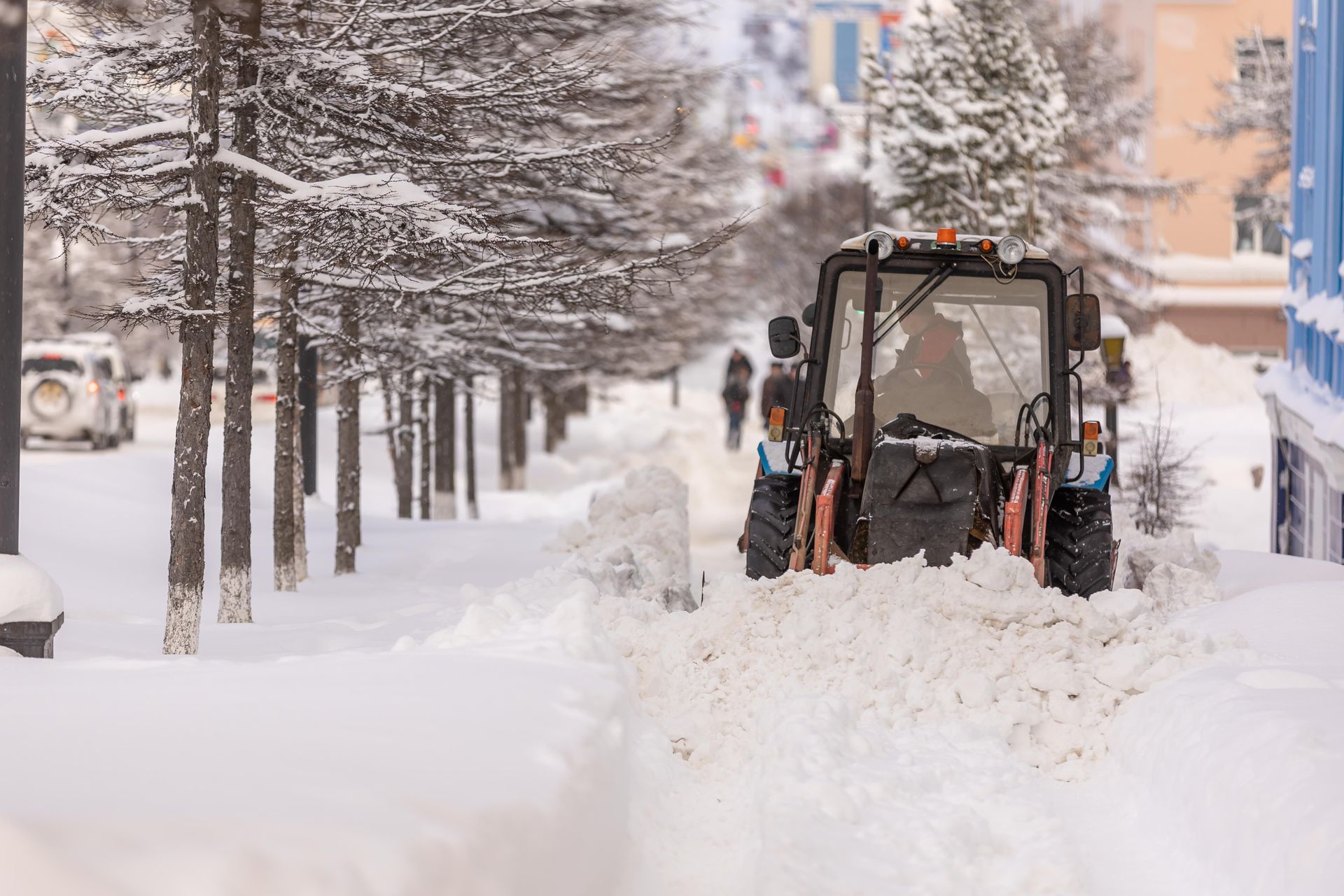
Plowing does one thing extremely well: bulk snow relocation from paved surfaces. A commercial snow plowing operation can open a lot, drive lanes, and parking rows far faster than any other method. What plowing does not do is eliminate the residual thin layer, the compaction from tires, or the ice that forms when that thin layer goes through a freeze cycle. Expect a clean lot, not a bare-and-dry lot, from plowing alone.
In the industry generally, plowing is tied to accumulation thresholds and timing windows defined in the contract, and those are exactly the terms you should read carefully before signing. We will not define standard contract terms here, but our post on what to look for in a snow removal contract before winter hits covers that ground.
The timing question is a planning consideration you own: when do tenants and customers arrive, and what must be clear by then? A property that fills up at 8 a.m. has different needs than one that opens at 10. A snow plowing service that runs overnight or early-morning windows exists precisely because of that question, and it is worth asking how your property's schedule fits the provider's.
De-Icing and Salting
De-icing addresses what plowing leaves behind: the residual layer, the packed snow in walkway traffic paths, and the refreeze that shows up overnight. This is the service that keeps an entrance walkable at 7 a.m. after a 3 a.m. storm.
In general terms, material choice and application approach vary with temperature and surface type, and over-application has real costs, both in material and in runoff considerations. The FHWA manual of practice for anti-icing explains the underlying concepts well, including the distinction between anti-icing, which prevents the bond between ice and pavement, and de-icing, which breaks it after the fact. Those are different strategies with different timing, and a provider should be able to tell you which one they are using and where.
Alpine provides de-icing and salting as part of our snow and ice management services, applied with attention to the surfaces and temperatures on your specific property.
Ongoing Winter Maintenance Plans
The third building block is structure. Single-event service and ongoing winter maintenance plans differ in ways that matter across a full season: predictability of cost, priority status during back-to-back storms, and coverage for the storm that hits at 2 a.m. versus the one that hits at 2 p.m. A property that only calls when it snows is competing for attention with every other property making the same call. An ongoing plan puts your site in a defined rotation. Ongoing winter maintenance plans are part of Alpine's snow and ice management offering, and the right structure depends on your property and season.
Here is a quick comparison of the four elements we have covered:
| Service element | What it addresses | Planning question to answer |
|---|---|---|
| Plowing | Bulk snow from lots, drive lanes, and parking areas | What must be passable, and by what time of day? |
| De-icing and salting | Residual layers, refreeze, and packed snow on walkways and entrances | Which surfaces refreeze overnight, and who walks them first? |
| Ongoing winter maintenance plan | Coverage across the whole season, including overnight and back-to-back events | How many storms per season, and can the property tolerate gaps? |
| Snow stacking and pile placement | Where snow goes and how it drains | Where can piles sit without blocking access or sight lines? |
Western Colorado Realities That Shape the Plan
Geography matters here more than in most places. Montrose and the surrounding valley sit at an elevation where repeated storms, wind, and freeze-thaw cycles are the winter norm, and the surrounding high country runs colder, snowier, and windier still.
Three practical realities shape most local plans. Wind drifting on open lots can rebuild a windrow in hours, sometimes requiring repeated passes within a single storm event. Freeze-thaw means the melt from Monday afternoon is very plausibly the ice sheet on Tuesday morning, especially on shaded surfaces. And sun exposure varies across a single property: the south-facing lot in full sun may clear itself by noon while the north entrance stays packed and icy for days. The same storm behaves differently on different sides of the same building, and your plan should reflect that rather than treat the property as one uniform surface.
What Drives the Cost of Commercial Snow Removal
We are not going to invent dollar figures here. Your property is not a template. The factors that drive quotes are still consistent, and knowing them helps you compare bids intelligently.
Paved area and walkway footage. More surface means more time on the lot and more material on the walks. A property with heavy parking and minimal walkway has a different cost profile than a building with a small lot and long approach paths.
How the service is structured. Per-event and seasonal structures distribute cost differently across a winter, and a light winter versus a heavy one changes which structure looks better in hindsight. This is a contract conversation, and the right answer depends on your risk tolerance as much as the weather.
Service timing. Overnight and early-morning windows, the ones that get the lot ready before anyone arrives, are a different operational commitment than business-hours visits.
De-icing material volume. This scales with walkway footage and refreeze frequency. A property with long shaded entrances burns more material than a compact sun-exposed site.
Travel distance. Across a Western Slope service area, how far your property sits from the provider's base affects what it takes to serve you, especially in back-to-back events.
Site complexity. Curb lines, parking islands, landscaping edges, tight entrances, and the amount of hand work your walkways require all add time. Two lots of identical square footage can be very different jobs.
Storm frequency. A season with twelve storms hits per-event properties differently than a seasonal plan. That variance is real and worth thinking about before, not after, the winter in question.
Which answers the question property managers ask most often: why do two similar-sized lots get different quotes? Because the quote reflects paved area plus structure plus timing plus material plus distance plus complexity plus expected frequency. When you compare bids, compare them against those factors, not against square footage alone.
When DIY Stops Making Sense on a Commercial Property
A shovel and a bag of melt can handle a small storefront stoop before opening. Plenty of small businesses do exactly that, and it works.
But the line gets crossed somewhere, and it is worth knowing where. It usually starts with employee safety. Putting a staff member on a slippery lot at 4 a.m. with a walk-behind or a pickup plow shifts real risk onto your business, and OSHA's winter slip-prevention guidance exists because employers carry duties around known hazards on walking surfaces. The person clearing that lot also has another job, and a commercial lot cannot realistically be cleared before opening with residential-grade equipment anyway.
Then there is consistency. Commercial properties need reliable, repeatable service across every storm, including the overnight ones, and records of that service matter if a slip claim or an insurance question ever arises. Professional crews working ongoing plans are also generally positioned to return for repeat passes during long storms. That is a general industry observation, not a promise about any specific provider's response, but it reflects how prioritization actually works in a busy event.
The takeaway is simple: the bigger your paved footprint and the more user groups on the property, the earlier DIY stops being viable. For a lot of commercial properties, that line gets crossed in the first serious storm of the season.
How to Vet a Local Snow Removal Provider
Whoever you hire, ask these questions before you sign anything:
- What areas of the property will be covered, in what order, and where will snow be stacked?
- How is service structured: per event, seasonal, or an ongoing plan? Get their terms in writing and read them.
- What de-icing approach do they use, and where on the property do they apply it?
- Are they familiar with your property's specific conditions: elevation, wind exposure, drainage, tenant access hours?
- Who do you call mid-storm, and how is communication handled?
Watch for a few red flags. Vague answers about coverage areas and pile placement suggest they have not thought about your site specifically. No clear point of contact during storms is a problem you will discover at the worst possible time. Reluctance to walk the property before quoting means the quote is a guess. And pricing that seems disconnected from your actual paved area is worth questioning, in both directions.
Where APS Alpine Property Services Fits
Alpine is a family-owned Montrose company serving since 1995, with over 50 years of combined experience. The team provides commercial snow removal and snow management for commercial customers of any size, along with de-icing, salting, and ongoing winter maintenance plans. The company also offers competitive pricing and stands behind its work.
One practical advantage of a year-round property-services crew: the same team that manages snow and ice in winter also handles asphalt maintenance, parking lot painting, and landscaping the rest of the year. That continuity matters when you decide where snow stacks go this winter and what the pavement looks like in spring.
Next Steps: Build the Plan Before the First Storm
Winter planning is not complicated, but it does need to happen before the first storm, not during it. Walk your property, list your zones, think through access priorities and pile placement, and get your questions answered while the ground is still dry.
If you want to talk it through, call us at (970) 765-5904 for a free estimate or reach us through the contact page. We will walk the property with you, talk through coverage areas and priorities, and figure out what an ongoing winter plan would look like for your site.